

Why the Upper West Side Still Feels Like “Old New York”
People use the phrase “old New York” all the time.
Usually, they’re talking about something that disappeared. A restaurant that closed. A building that was demolished. A version of the city they remember from twenty or thirty years ago.
But walk around the Upper West Side and the phrase means something a little different.
It isn’t that the neighborhood hasn’t changed. Of course it has. New buildings have gone up, restaurants have come and gone, and Broadway today looks different than it did a generation ago.
What strikes me about the Upper West Side is how much of its past still participates in everyday life.
You can live in an apartment building constructed a century ago, buy smoked fish from a family business that has been in the neighborhood since the 1930s, walk through a park conceived by Frederick Law Olmsted, and end the night at Lincoln Center.
None of those things are preserved behind glass. They’re just part of living here.
And I think that has a lot to do with why the Upper West Side still feels like old New York.
A neighborhood built over generations
Before the brownstones, prewar apartment houses and the busy stretch of Broadway we recognize today, much of the Upper West Side was known as Bloomingdale.
For a surprisingly long time, this part of Manhattan remained relatively undeveloped. Bloomingdale Road ran north through the area and eventually became Broadway. The creation of Central Park and, later, new transit connections helped transform what had been a landscape of farms and country estates into an increasingly desirable residential neighborhood. By the 1880s, development was accelerating.
What followed is still remarkably easy to read in the architecture.
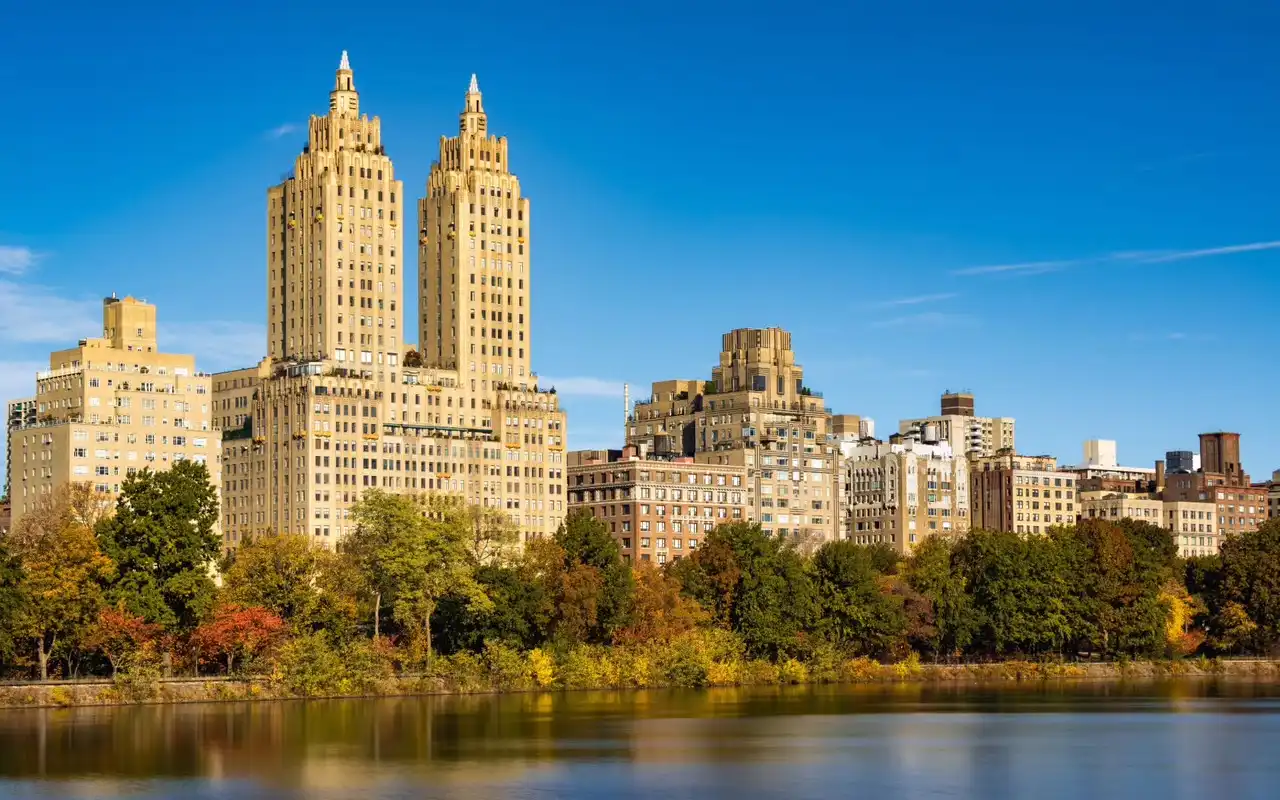
Walk the side streets and you see rows of late-19th-century brownstones. Along Broadway, Amsterdam and Columbus, the scale and character change. And along Central Park West rise the grand apartment buildings that helped redefine how affluent New Yorkers thought about apartment living.
Much of the Upper West Side–Central Park West Historic District developed from the 1880s through the 1930s. The result is an unusual mixture of row houses, tenements, storefronts and apartment buildings in styles ranging from Romanesque Revival and Beaux-Arts to Neo-Renaissance and Art Deco.
You don’t have to know any of those architectural terms to feel it. Just walk.
That is one of my favorite things about this part of Manhattan. A few blocks can completely change your experience of the neighborhood.
Central Park West changed the idea of apartment living
The Dakota opened in 1884, at a time when the Upper West Side was still being developed.
Then came another generation of grand apartment houses.
The Brentmore at 88 Central Park West was completed in 1910. The Beresford arrived in 1929. The San Remo followed in 1930. Much later, 15 Central Park West translated that same basic proposition, large-scale apartment living directly facing Central Park, for another era.
Different architects. Different decades. Different versions of New York. But the idea connecting them is remarkably consistent.
Central Park wasn’t simply nearby. It became part of the experience of the home.
I’ve been thinking about that a lot lately because I’m representing a residence at The Brentmore that hasn’t been on the market in 33 years. There is something telling about that number.
We talk a lot in real estate about what makes a home desirable. Views. Layout. Architecture. Location. But one of the less measurable characteristics of the Upper West Side is permanence.
People stay. Many times for decades.
The neighborhood institutions stayed, too
That continuity isn’t limited to residential buildings.
Zabar’s began on Broadway at West 80th Street in 1934. More than 90 years and four generations later, the family business is still there.
Barney Greengrass is even older. The business was founded in Harlem in 1908 and moved to its current Amsterdam Avenue location in 1929. Nearly a century later, people still line up for smoked fish, eggs and sturgeon in a space that proudly retains much of its old character.
That matters. Not because a neighborhood should remain frozen in time, it shouldn’t, but because businesses like these give a place continuity.
They become reference points.
You give directions using them. You develop rituals around them. Parents bring children, who eventually bring their own children. The person who moved to the neighborhood six months ago and the person who has lived there for forty years can both have a Saturday morning routine that involves the same counter.
In a city where reinvention is practically a civic sport, there is something reassuring about that.
Then there are the two parks
The Upper West Side also has something almost no other Manhattan neighborhood can claim at this scale: major parkland on both sides.
Central Park defines its eastern edge.
Riverside Park and the Hudson define the west.
And they provide two completely different versions of outdoor life.
Central Park gives you some of the most recognizable landscapes in New York. Sheep Meadow alone is 15 acres, sitting between West 66th and 69th Streets, and remains one of the park’s great places to picnic, read, sunbathe or simply do nothing for an afternoon. Farther north, the Reservoir has become one of the city’s iconic running routes.
Riverside feels different.
It is narrower, more layered and more intimately tied to the Hudson. Frederick Law Olmsted prepared the conceptual plan for Riverside Park and Riverside Drive in the 1870s, working with the existing topography to create a landscape of curving paths, rock outcroppings and river views. Later generations expanded and altered it, and Riverside Park South eventually extended public waterfront space below 72nd Street onto former rail-yard land.
Living between the two means your morning can start with a walk along the Hudson and your afternoon can end in Central Park.
That doesn’t feel like access to an amenity. It feels like having two backyards.
Culture here is part of the routine
And then there is Lincoln Center.
The Metropolitan Opera, New York Philharmonic, New York City Ballet, Juilliard, Film at Lincoln Center, Lincoln Center Theater and the New York Public Library for the Performing Arts are concentrated around the same campus.
Farther north, the American Museum of Natural History anchors Central Park West. The Beacon Theatre has been part of Broadway since 1929.
It creates a version of city life I find particularly appealing. You don’t necessarily have to plan an entire evening around “going out in the city” to see something. You’re already there.
Dinner and the Philharmonic can be a neighborhood night. A museum can be an afternoon activity. Central Park can be your morning walk.
And Zabar’s can still be where you realize at 5:00 p.m. that you have nothing for dinner.
That combination of world-class culture embedded into the mechanics of ordinary life is one of the Upper West Side’s great luxuries.
Old New York isn’t really about age
Maybe this is ultimately what people are responding to when they say the Upper West Side feels like old New York.
Yes, the architecture helps. So do the brownstones, prewar lobbies, corner restaurants, old theaters and businesses whose signs have been hanging over Broadway and Amsterdam for generations.
But I think it is more about continuity than nostalgia.
The neighborhood has changed enormously since the days when Bloomingdale Road ran through a relatively undeveloped West Side. It will keep changing. It should.
But enough has remained that you can still understand what came before.
The buildings have history, but people still live in them. The shops are institutions, but people still buy groceries in them. The parks are landmarks, but people still run through them before work.
And the cultural institutions that draw visitors from around the world are, for the people who live nearby, also just part of the neighborhood.
Old New York isn’t something you have to recreate here. In many ways, it never left.
Social Cookies
Social Cookies are used to enable you to share pages and content you find interesting throughout the website through third-party social networking or other websites (including, potentially for advertising purposes related to social networking).