Hudson Square is for buyers who want access to the prime downtown neighborhoods and the kind of housing stock associated with them, at a more attainable price.
It sits directly between SoHo, Tribeca, and the West Village, which makes the location about as central as downtown gets. Unlike those neighbors, which have spent years as some of the most in-demand areas in the city, Hudson Square is a newcomer, and that is exactly where the opportunity is for the right buyer.
This is a buyer who is comfortable being early to a neighborhood still finding its identity rather than buying into one that is already fully formed.
Hudson Square runs from Clarkson and Houston Streets south to Canal, between Sixth Avenue and the Hudson River.
The neighborhood spent most of the 20th century as a printing and industrial district, and its zoning barred residential development entirely. The building stock reflects that history: large prewar commercial and loft buildings, wider streets, and a heavier scale than neighboring SoHo.
The neighborhood turning point was the 2013 rezoning. Trinity Real Estate, the property arm of Trinity Church and the owner of roughly 40 percent of the neighborhood, initiated the largest privately led rezoning in the city. It allowed residential development in Hudson Square for the first time and attached the Hudson Square name to a deliberate repositioning of the former industrial district.
Major corporations followed. Disney built its New York headquarters at 7 Hudson Square, opening in 2024. Google built its New York headquarters at St. John's Terminal on Washington Street and assembled an office campus along Hudson Street. These arrivals reshaped the neighborhood's daytime population and brought in a pool of new residents, which subsequently ushered in residential new development.
The result is a neighborhood still in transition. The commercial and creative-industry side is well-established. The residential side is newer, concentrated in a tier of condo buildings that have become available since the rezoning, with daily-life retail and dining still finding its footing.
Hudson Square's housing stock is overwhelmingly newer condo, concentrated in the western and southern blocks toward the Hudson.
The recent condo development is the defining tier. Greenwich West at 110 Charlton Street (170 condos, 2020) is the largest of the recent ground-up buildings. 570 Broome Street (54 condos, 2019), 100 Vandam (72 condos, 2021), and 219 Hudson (2023) fill in the boutique new-construction tier. The Urban Glass House at 330 Spring Street, one of the last residential buildings designed by Philip Johnson, brought architectural pedigree to the neighborhood when it was completed in 2006.
The loft-conversion tier is smaller. A number of the prewar printing-district buildings have been converted to residential use, offering larger floor plans and the industrial character of the original construction.
Because the residential stock skews so heavily new, buyers here are generally choosing among contemporary condo buildings with modern systems and amenity packages. Buyers who want a classic SoHo cast-iron loft will be looking in SoHo proper, not here.
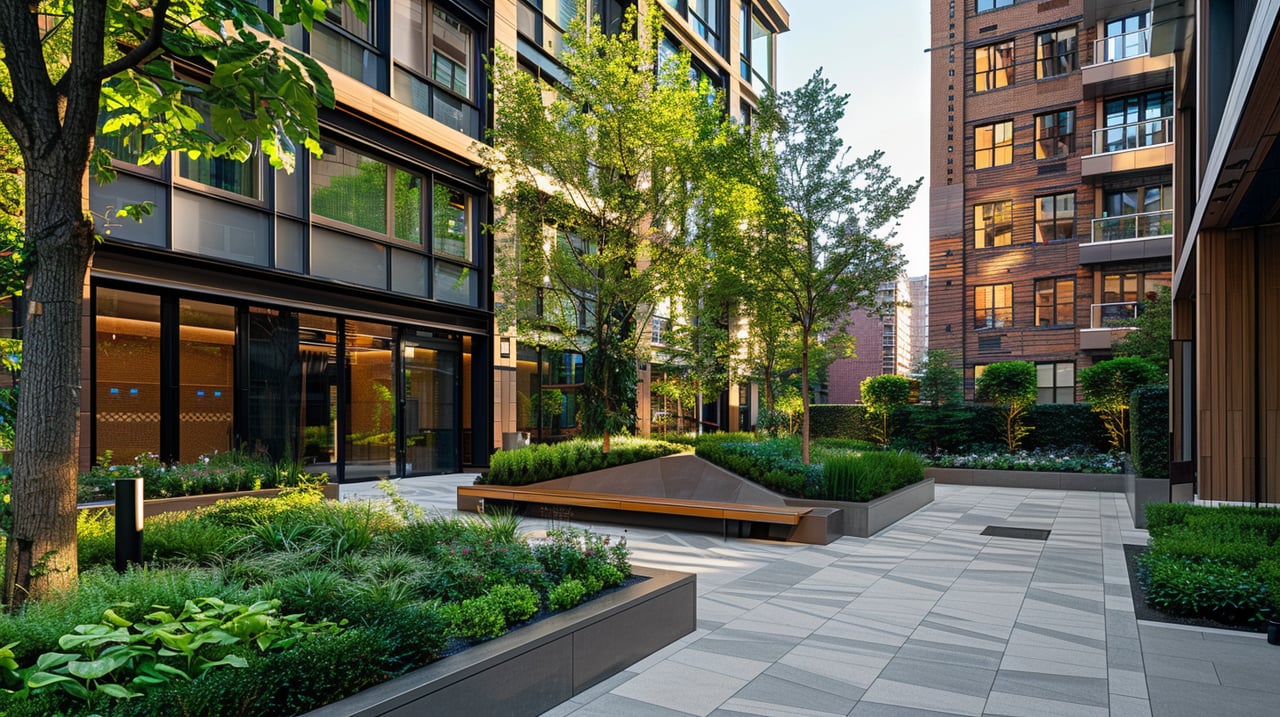
Hudson Square is still building its residential identity. During the work week the neighborhood revolves around its creative-industry base, and the daily-life retail, dining, and residential texture that define a settled neighborhood are still filling in. Buyers who want a fully formed residential neighborhood will feel what is missing.
The inventory is thin and skews new. Buyers who want a large selection, or who want prewar character, will generally not find that here.
The neighborhood's edges blur into SoHo, Tribeca, and the West Village, which is both an advantage and a question. The location is central, but Hudson Square does not yet have the distinct residential identity its neighbors carry, and some buyers will find they are effectively buying SoHo-adjacent or Tribeca-adjacent rather than buying into a neighborhood with its own settled character.
For the right buyer, that is the opportunity. Hudson Square offers downtown location and newer construction at pricing that has not yet caught up to Tribeca or the West Village, and the buyer who is comfortable being early tends to see the value before the rest of the market does.
Local Highlights
Eat & Drink
Restaurants, Cafés & Bars
Arts & Culture
Galleries, Museums & Venues
29,772 people live in Hudson Square, where the median age is 39.4 and the average individual income is $166,520. Data provided by the U.S. Census Bureau.
Total Population
Median Age
Population Density
Average individual Income
There's plenty to do around Hudson Square, including shopping, dining, nightlife, parks, and more. Data provided by Walk Score and Yelp.
Explore popular things to do in the area, including Charles Gourmet Produce, Barrese Newsstand, and Alie Flynt LCSW.
| Name | Category | Distance | Reviews |
Ratings by
Yelp
|
|---|---|---|---|---|
| Dining · $ | 0.12 miles | 2 reviews | 1/5 stars | |
| Shopping | 0.31 miles | 0 reviews | 0/5 stars | |
| Active | 0.22 miles | 0 reviews | 0/5 stars | |
| Beauty | 0.25 miles | 0 reviews | 0/5 stars | |
| Beauty | 0.38 miles | 0 reviews | 0/5 stars | |
| Beauty | 0.39 miles | 0 reviews | 0/5 stars | |
|
|
||||
|
|
||||
|
|
||||
|
|
||||
|
|
||||
|
|
Hudson Square has 17,682 households, with an average household size of 1.66. Data provided by the U.S. Census Bureau. Here’s what the people living in Hudson Square do for work — and how long it takes them to get there. Data provided by the U.S. Census Bureau. 29,772 people call Hudson Square home. The population density is 61,400 and the largest age group is Data provided by the U.S. Census Bureau.
Total Population
Population Density Population Density This is the number of people per square mile in a neighborhood.
Median Age
Men vs Women
Population by Age Group
0-9 Years
10-17 Years
18-24 Years
25-64 Years
65-74 Years
75+ Years
Education Level
Total Households
Average Household Size
Average individual Income
Households with Children
With Children:
Without Children:
Blue vs White Collar Workers
Blue Collar:
White Collar: